21st August 2026
TL;DR: Free weights should form the base of most programmes because they build coordination, stability and strength that transfers outside the gym. Machines are excellent for adding volume safely, isolating a lagging muscle and training hard when you are tired or coming back from a niggle. The best programmes use both, with the ratio shifting based on your experience and your goal. At Fitness Extreme, a strength training gym in Andheri West, the free weights floor and machines sit together so you never have to choose one camp.
For most people, free weights build the base and machines fill it out. Squats, deadlifts, presses, rows and loaded carries ask your whole body to coordinate and stabilise while producing force, and that is the quality that carries over to daily life, sport and long term joint health.
That said, the debate is far less fierce than the internet suggests. Research consistently points to both tools producing meaningful strength and muscle gains when effort and progression are matched. A machine chest press taken close to failure is not a lesser exercise than a dumbbell press in any way that matters for muscle growth. The differences lie in skill, stability demand and how the load is distributed.
So the real question is not which is better. It is which one is better for you, for this exercise, on this day, given your training age and what you are trying to achieve.
Free weights force your body to control the load in three dimensions. Nothing holds the path for you, so the small stabilising muscles around the shoulder, hip and spine have to work. Over time that builds a kind of robustness that a fixed path cannot replicate.
They also let you train movement patterns rather than individual muscles. A trap bar deadlift trains the hinge, the grip, the upper back and the legs at once, and it teaches you how to brace. That efficiency matters when you have four hours a week to train, not ten.
Machines earn their place for reasons that have nothing to do with being easier. They let you push a set genuinely close to failure without needing a spotter or worrying about a technique breakdown under fatigue. That is a real advantage when you are chasing muscle growth.
They also isolate well. If your upper back is lagging behind your chest, a chest supported row lets you hammer exactly that without your lower back becoming the limiting factor. Similarly, a leg curl trains the hamstrings in a way that squats simply do not.
Machines are also the sensible choice when you are training around a niggle, coming back from a break, or arriving at the gym after a punishing workday with poor focus. On those days, a fixed path is a feature, not a compromise.
If you are new to training, spend the first several months learning free weight patterns with light load and good coaching. The skill acquisition is the point. Machines can still fill out your volume, but the technique investment early pays off for decades.
Once you are competent under the bar, a common structure is to open each session with one or two free weight compound lifts while you are fresh, then move to machines for the accessory volume. You get the coordination and strength benefit when it counts and the fatigue tolerant, easy to progress work afterwards.
Advanced lifters often swing further towards machines for accessory work, precisely because their compound lifts are heavy enough that recovery becomes the constraint. That is not a step backwards. It is a sensible allocation of effort.
The free weight purist avoids machines out of principle and ends up with a weak point they never address, usually the hamstrings, rear delts or upper back. The machine loyalist never learns to brace under a bar and finds that their gym strength does not show up when they lift a suitcase or play a Sunday sport.
Both are avoidable. The tool is not the programme. Progressive overload, sensible weekly volume, adequate protein and consistent sleep are what actually drive results, and every one of those is tool agnostic. If you are arguing about equipment while training twice a month, the equipment is not the problem.
A strength base is not the whole picture either. Cardiovascular fitness, work capacity and movement variety all matter, and for a lot of busy professionals a structured class is the most reliable way to get them. GroupX classes Andheri West members attend two or three times a week sit comfortably alongside a two or three day lifting programme without competing with it.
The trick is scheduling. Put your heaviest free weight sessions on days when you are fresh, and place classes so they do not land the day before a big lower body day. A coach can lay that out in one conversation.
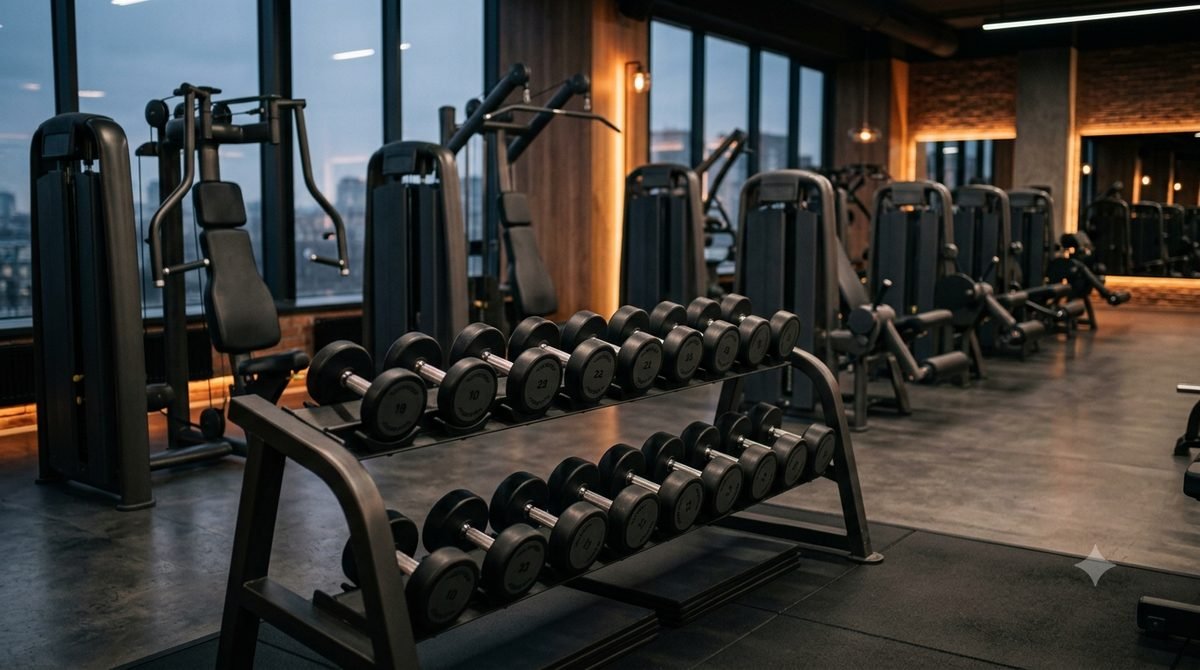
At Fitness Extreme, the strength and free weights floor, the cardio zones, GroupX classes and personal training all live under one roof at Oshiwara, opposite Moxy Mumbai Hotel, serving Lokhandwala, Versova, Oshiwara and Juhu. That means you are never forced to build a programme around whatever the equipment allows.
If you are unsure where to start, book a session with a coach and get your free weight technique assessed first. Once the squat, hinge, press and row look solid, adding machine work is trivial. Doing it the other way round takes far longer, and the recovery suite with steam and sauna, an ice plunge, red light therapy and deep tissue work is there for the weeks when you push the free weight side harder than usual.
Book a free trial at Fitness Extreme, Andheri West. Fill in the enquiry form on our contact page, WhatsApp us, or call +91 89283 44231. To see the full free weights floor and get a programme built around it, visit our strength training gym in Andheri West.